A recorded engine loop can sound right at one RPM and wrong everywhere else.
The problem
Most engine sounds in a browser are recordings with a playback rate tied to RPM. They can sound convincing at one operating point, but they do not respond like a physical system when the throttle, load, or exhaust geometry changes.
FullSound synthesizes the sound instead. The audio path starts with a cylinder pressure model, adds intake and mechanical sources, and runs the exhaust through a per-preset pipe network solved with finite-difference time-domain physics in Rust/WASM. The result is an engine note that changes with RPM and throttle rather than a loop being pitched up and down.
The build
The architecture is split across three execution contexts. An AudioWorklet processor owns the audio thread and consumes samples from a lock-free ring buffer. A Web Worker runs the simulation loop and builds the pipe network for the active preset. The two communicate through SharedArrayBuffer ring buffers, with a postMessage fallback when cross-origin isolation is unavailable.
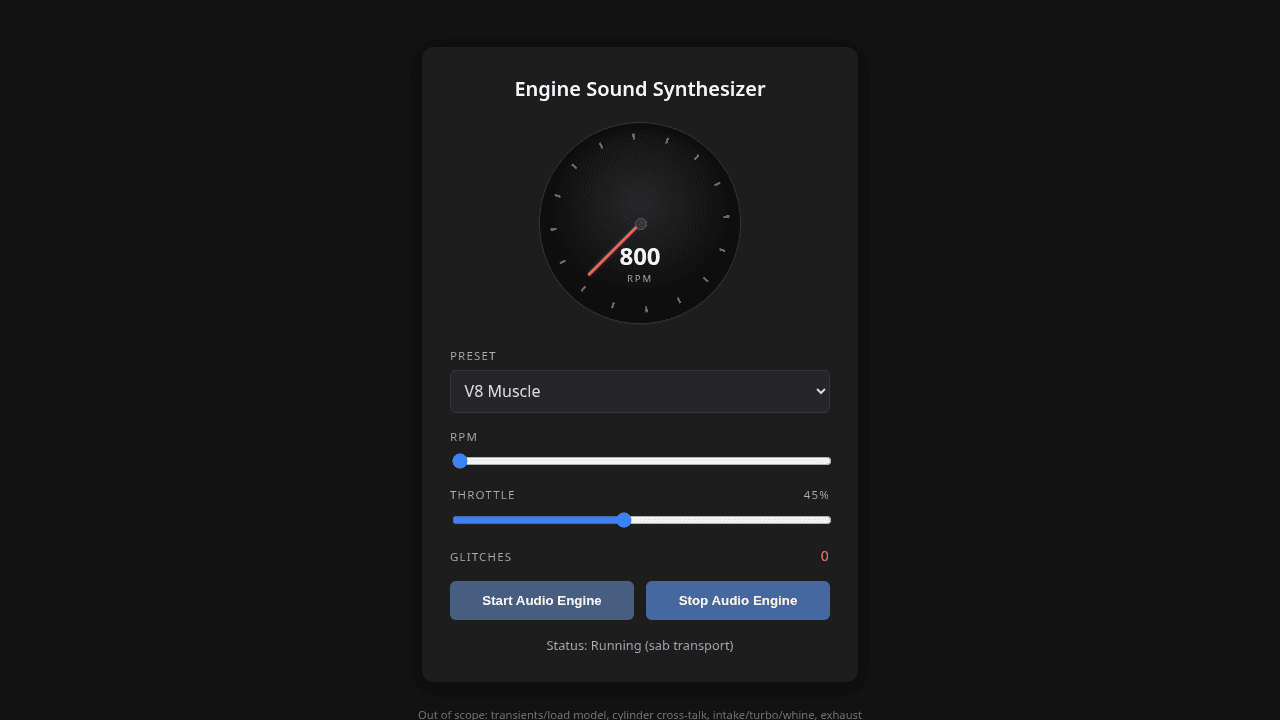
That boundary mattered more than any individual DSP block: the audio thread must never wait for the simulation, and a missed deadline should degrade gracefully instead of blocking playback. The demo exposes RPM and throttle controls, a preset selector, a tachometer, a glitch counter, and a failure table. Six engine configurations are available, from an inline-four and V6 to a V8 crossplane, flat-four, rotary Wankel, and two-stroke single.
A Three.js view uses the same engine model to animate the crankshaft, pistons, valves, turbo, and Wankel rotor, with live telemetry for RPM, exhaust temperature, manifold pressure, air/fuel ratio, and per-cylinder combustion. The visualisation targets 60 fps and drops detail on low-end devices rather than hiding the physics. I kept the engine configurations data-driven so the audio and visual layers read the same preset definition.
The failure table made audio dropouts, missed deadlines, and fallback behaviour visible during development, which is essential when a problem in the audio thread can sound like a bad preset. I would rather ship a system that tells the user it is degrading than one that hides the failure behind a convincing noise.
The result
FullSound is a browser-native engine simulator with real-time audio synthesis, WASM pipe physics, and a live Three.js engine view. It runs locally through Vite; the test suite and production build are the reproducible evidence.
What I took from it
The project made real-time boundaries concrete. The interesting part was keeping the audio thread deterministic while a separate worker ran a heavier simulation and a renderer drew the result. A single DSP block sounding good in isolation was only one part of the problem. That is the part I would carry into another simulation project: make the physical model the shared source of truth, then treat audio and graphics as two views of it.